Essential German Phrases: A Quick Reference
Learn essential German phrases for beginners. From greetings to beer hall etiquette, master the basics with cultural context about Sie/du formality and everyday expressions.
Essential German Phrases: A Quick Reference
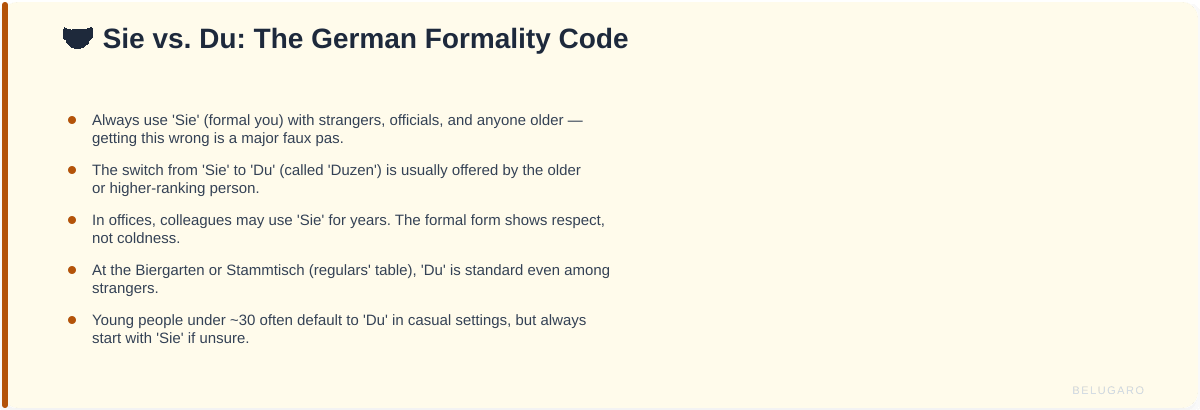
You've just landed in Frankfurt. You ask an older gentleman for directions using the informal du. He stiffens. Eyebrows up. You've just committed one of the most common foreigner mistakes in Germany — and you didn't even know it.
Sie vs. Du: The Rule You Cannot Break
Sie = formal "you." Use with strangers, in shops, with bosses, with anyone older. Du = informal "you." Friends, family, children, and people who've explicitly invited you to use it.
The switch from Sie to du is called Duzen — sometimes a colleague will even toast to it. Until that happens, stick with Sie. Always.
| Situation | Use |
|---|---|
| Stranger on the street | Sie |
| Waiter at a restaurant | Sie |
| Your boss (unless they offer du) | Sie |
| Close friends | du |
| Children | du |
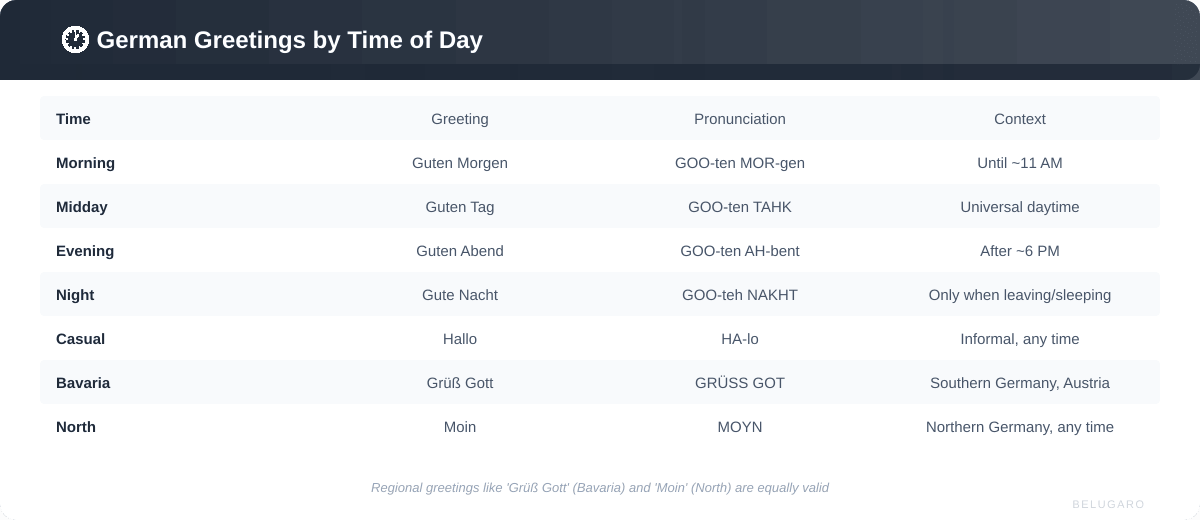
Greetings
| Greeting | Where | Formality |
|---|---|---|
| Guten Tag | Everywhere (safe default) | Formal |
| Hallo | Everywhere | Neutral |
| Moin | Northern Germany | Informal (works all day, despite sounding like "morning") |
| Grüß Gott | Bavaria, Austria | Formal/regional |
| Tschüss | Everywhere | Informal goodbye |
| Auf Wiedersehen | Everywhere | Formal goodbye |
At the Biergarten
In a traditional Biergarten, long wooden tables are shared by strangers. Nobody finds this strange. One essential phrase:
"Ist hier noch frei?" — "Is this seat free?" (It's not really a question. You're about to sit down.)
| German | English |
|---|---|
| Ein Bier, bitte | One beer, please |
| Noch eins, bitte | Another one, please |
| Prost! | Cheers! |
| Die Rechnung, bitte | The check, please |
| Getrennt, bitte | Separate checks, please |
| Guten Appetit | Enjoy your meal |
Pronunciation tip: The German "ch" (as in Rechnung) doesn't exist in English. Place your tongue like you're about to say "k," but let the air hiss through instead of stopping. Practice with "ach."
Getting Around
| German | English |
|---|---|
| Entschuldigung | Excuse me / I'm sorry |
| Wo ist...? | Where is...? |
| Wie komme ich zum Bahnhof? | How do I get to the train station? |
| Links / Rechts / Geradeaus | Left / Right / Straight ahead |
Shopping & Emergencies
| German | English |
|---|---|
| Was kostet das? | How much? |
| Ich schaue nur | Just looking |
| Kann ich mit Karte zahlen? | Can I pay by card? |
| Ich verstehe nicht | I don't understand |
| Sprechen Sie Englisch? | Do you speak English? |
Compound Words: Germany's Secret Weapon
German builds words like LEGO bricks. Once you spot the building blocks, you can decode words you've never seen.
| Compound | Literal meaning | Actual meaning |
|---|---|---|
| Handschuh | hand + shoe | glove |
| Kühlschrank | cool + cabinet | refrigerator |
| Flugzeug | fly + thing | airplane |
| Krankenhaus | sick + house | hospital |
| Staubsauger | dust + sucker | vacuum cleaner |
See -zeug (thing)? It's probably a device. See -haus? It's a building for something.
Quick Survival Tips
- "W" = "V" in German. Always. "Wo" = "vo," "Was" = "vas," "Wein" = "vine."
- "Bitte" means please, you're welcome, here you go, and go ahead. When in doubt, add bitte.
- Umlauts matter. "Schon" = already. "Schön" = beautiful. Those two dots change everything.
Start Practicing Naturally
These phrases are your foundation. Belugaro helps you build on it by weaving German vocabulary into the web pages you already browse — so words like Entschuldigung stop being items on a list and start being words you just know.
Learn Languages While You Browse
Belugaro translates words on any website, helping you build vocabulary naturally. Try it free.
Get the Chrome Extension