French Verb Conjugation: Less Scary Than It Looks
Learn French verb conjugation for essential tenses. Visual charts for -er, -ir, -re verbs plus key irregulars like être, avoir, and aller.

French Verb Conjugation: Less Scary Than It Looks
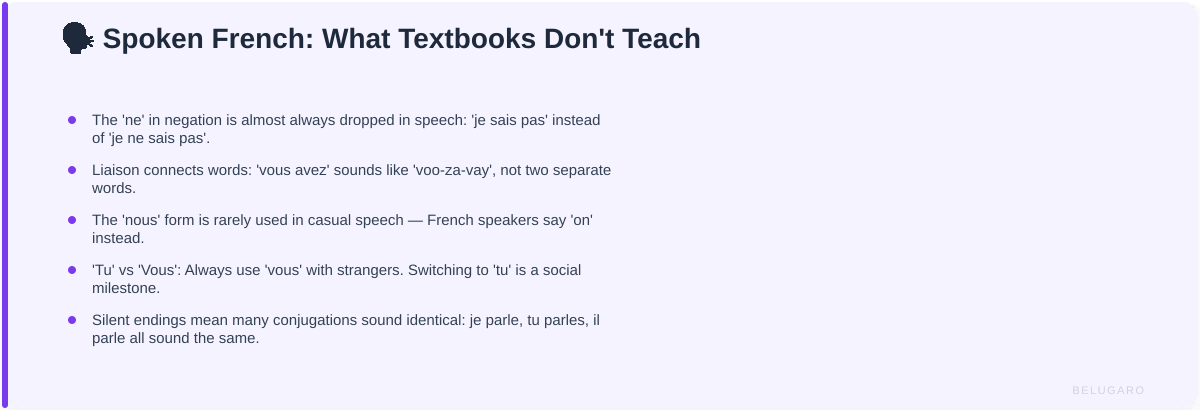
French conjugation hides an elegant secret: in spoken French, the system is far simpler than it appears on paper. Many of those different written forms? Pronounced identically.
The Three Groups
French verbs end in -er, -ir, or -re. About 90% are -er verbs — and nearly all new French words (like googler) follow that pattern.
Present Tense
| Pronoun | parler (-er) | finir (-ir) | vendre (-re) |
|---|---|---|---|
| je | parle | finis | vends |
| tu | parles | finis | vends |
| il/elle/on | parle | finit | vend |
| nous | parlons | finissons | vendons |
| vous | parlez | finissez | vendez |
| ils/elles | parlent | finissent | vendent |
The Spoken French Secret
For -er verbs, je parle, tu parles, il parle, and ils parlent all sound exactly the same: /parl/. Four spellings, one pronunciation. Only nous and vous sound different. In conversation, context does the heavy lifting.
Passé Composé: The Past Tense You Actually Use
Built from a helper verb (avoir or être) + past participle.
| Group | Participle pattern | Example |
|---|---|---|
| -er → -é | parler → parlé | J'ai parlé (I spoke) |
| -ir → -i | finir → fini | J'ai fini (I finished) |
| -re → -u | vendre → vendu | J'ai vendu (I sold) |
Movement/change-of-state verbs use être instead, and the participle agrees with the subject: Elle est allée (she went), Ils sont partis (they left). The classic mnemonic: DR MRS VANDERTRAMP.
Passé Composé vs. Imparfait
- Passé composé = completed event: J'ai mangé une crêpe ce matin.
- Imparfait = ongoing/habitual: Quand j'étais petit, je mangeais des crêpes tous les dimanches.
Together they create narrative: Je dormais quand le téléphone a sonné. (I was sleeping when the phone rang.) Background + foreground.
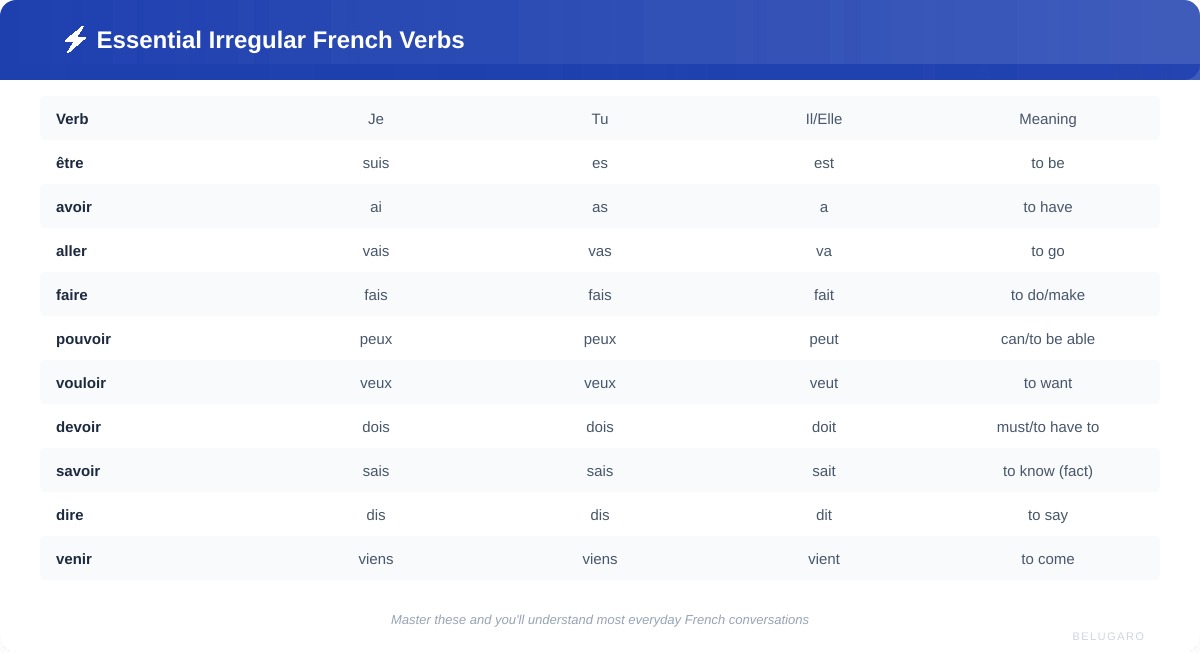
Five Verbs You Can't Avoid
| Verb | Present (je) | Meaning |
|---|---|---|
| être | suis | to be |
| avoir | ai | to have |
| aller | vais | to go |
| faire | fais | to do/make |
| pouvoir | peux | to be able to |
Aller also forms the near future: je vais manger (I'm going to eat). In everyday speech, this has mostly replaced the formal future tense.
Building Fluency
The gap between written and spoken French means reading and listening must work together. Belugaro bridges that gap by embedding French vocabulary into the websites you already browse — so you see ils parlent on screen while your brain connects it to the /parl/ you hear in conversation.
Learn Languages While You Browse
Belugaro translates words on any website, helping you build vocabulary naturally. Try it free.
Get the Chrome Extension