Italian Verb Conjugation: Espresso-Sized Grammar
Simplify Italian verb conjugation with clear visual charts. Master -are, -ere, -ire patterns and essential irregular verbs like essere, avere, and andare.
Italian Verb Conjugation: Espresso-Sized Grammar
Walk into a bar in Rome — not a cocktail bar, a bar in the Italian sense: coffee shop, social hub, neighborhood institution. Say "Un caffè, per favore." Drink your espresso in three sips, standing. Pay and leave. Ninety seconds.
Now try ordering a "latte." The barista hands you a glass of warm milk. Because latte means milk in Italian. What you wanted was a caffè latte.
Italian verbs come alive in everyday moments like these. So let's learn conjugation the Italian way: espresso in hand.
The Three Families: -ARE, -ERE, -IRE
| Group | Example | Meaning |
|---|---|---|
| -are (largest) | parlare | to speak |
| -ere | prendere | to take |
| -ire | dormire | to sleep |
Master -are verbs and you can conjugate hundreds of words.
Present Tense
| Person | -are (parlare) | -ere (prendere) | -ire (dormire) |
|---|---|---|---|
| io | parlo | prendo | dormo |
| tu | parli | prendi | dormi |
| lui/lei | parla | prende | dorme |
| noi | parliamo | prendiamo | dormiamo |
| voi | parlate | prendete | dormite |
| loro | parlano | prendono | dormono |
The -Isco Pattern
Some -ire verbs insert -isc- in the singular and loro forms. Capire (to understand): capisco, capisci, capisce, capiamo, capite, capiscono. Other -isco verbs: finire, preferire, pulire. No reliable rule for which — you learn them through exposure.
The Essential Irregulars
| Person | essere (to be) | avere (to have) |
|---|---|---|
| io | sono | ho |
| tu | sei | hai |
| lui/lei | è | ha |
| noi | siamo | abbiamo |
| voi | siete | avete |
| loro | sono | hanno |
Note: ho, hai, ha, and hanno all have a silent "h" — pronounced "o," "ai," "a," and "anno."
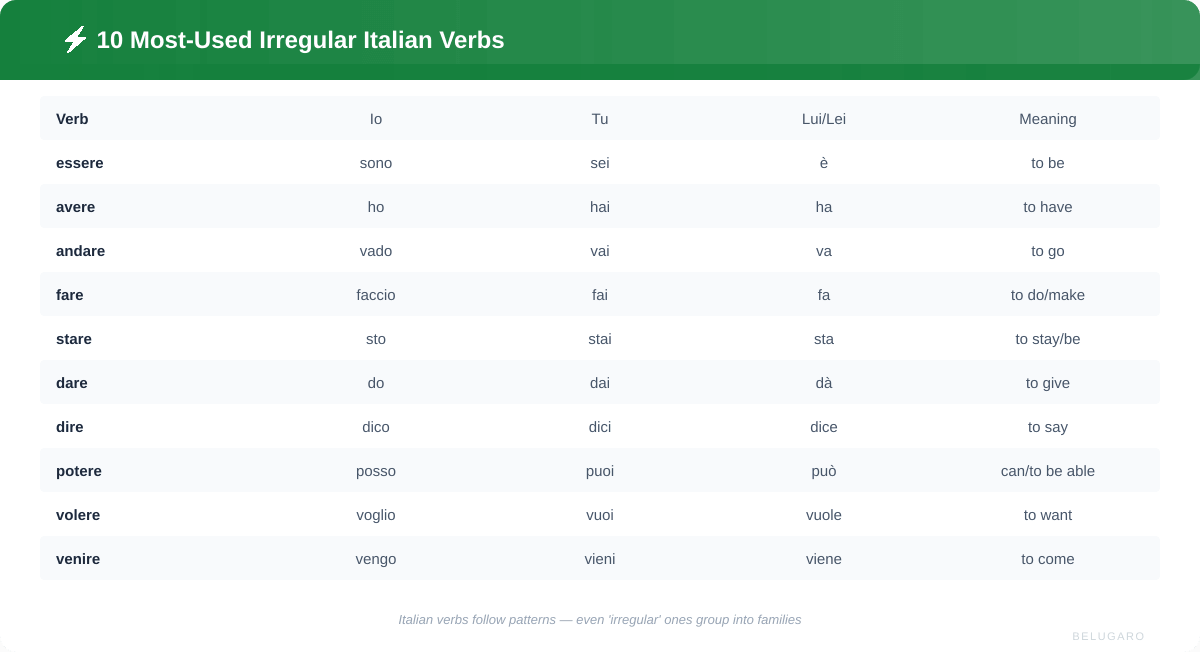
Other Verbs You'll Need Daily
| Verb | io | lui/lei | loro | Meaning |
|---|---|---|---|---|
| andare | vado | va | vanno | to go |
| fare | faccio | fa | fanno | to do/make |
| volere | voglio | vuole | vogliono | to want |
| potere | posso | può | possono | to be able |
| dovere | devo | deve | devono | to must |
Passato Prossimo: Talking About the Past
Helper verb (essere or avere) + past participle.
| Group | Participle | Example |
|---|---|---|
| -are → -ato | parlare → parlato | Ho parlato (I spoke) |
| -ere → -uto | avere → avuto | Ho avuto (I had) |
| -ire → -ito | dormire → dormito | Ho dormito (I slept) |
Most verbs use avere. Movement verbs use essere, and the participle agrees with the subject:
- Sono andato al bar. (I went — male)
- Sono andat*a al bar.* (I went — female)
- Sono partit*i stamattina.* (They left — mixed group)
Stare vs. Essere
Both mean "to be," but they're not interchangeable:
- Stare = health/feelings (Come stai? — How are you?) and present continuous (Sto mangiando — I'm eating)
- Essere = identity/origin (Sono italiano) and general states
Building the Habit
Italian conjugation has clear patterns and a manageable number of exceptions. The challenge is internalizing them until the right form comes naturally. Belugaro helps by introducing Italian vocabulary into your everyday web browsing — so when you see "ho preso un caffè" embedded in an article, the passato prossimo stops being a grammar rule and starts being something you simply know.
Learn Languages While You Browse
Belugaro translates words on any website, helping you build vocabulary naturally. Try it free.
Get the Chrome Extension