Japanese Greetings & Essential Phrases
Start learning Japanese with essential greetings and phrases. Understand bowing culture, keigo politeness levels, and everyday expressions with romaji pronunciation.
Japanese Greetings & Essential Phrases
In Japan, the wrong bow can say more than the wrong word. Tilt your head casually at a business meeting with a senior exec, and you've communicated disrespect before opening your mouth. Japanese communication is a system where gesture, grammar, and silence all carry meaning.
The Bow
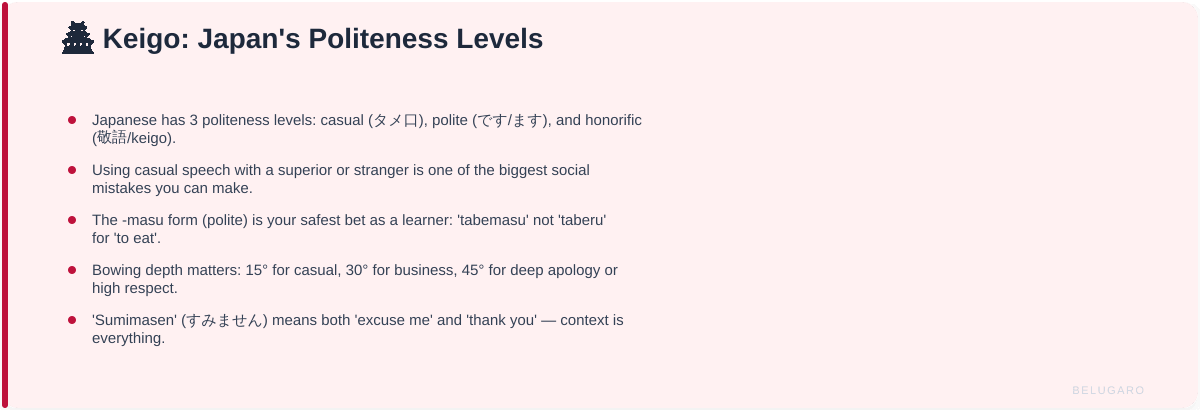
| Type | Angle | When |
|---|---|---|
| Eshaku (greeting) | ~15° | Casual greetings, passing colleagues |
| Keirei (respectful) | ~30° | Meeting clients, greeting superiors |
| Saikeirei (deep) | ~45° | Deep apology, sacred places |
Bow from the waist, not the neck. Back straight. Foreign visitors aren't expected to bow perfectly — but making the effort communicates respect that words can't.
Greetings by Time of Day
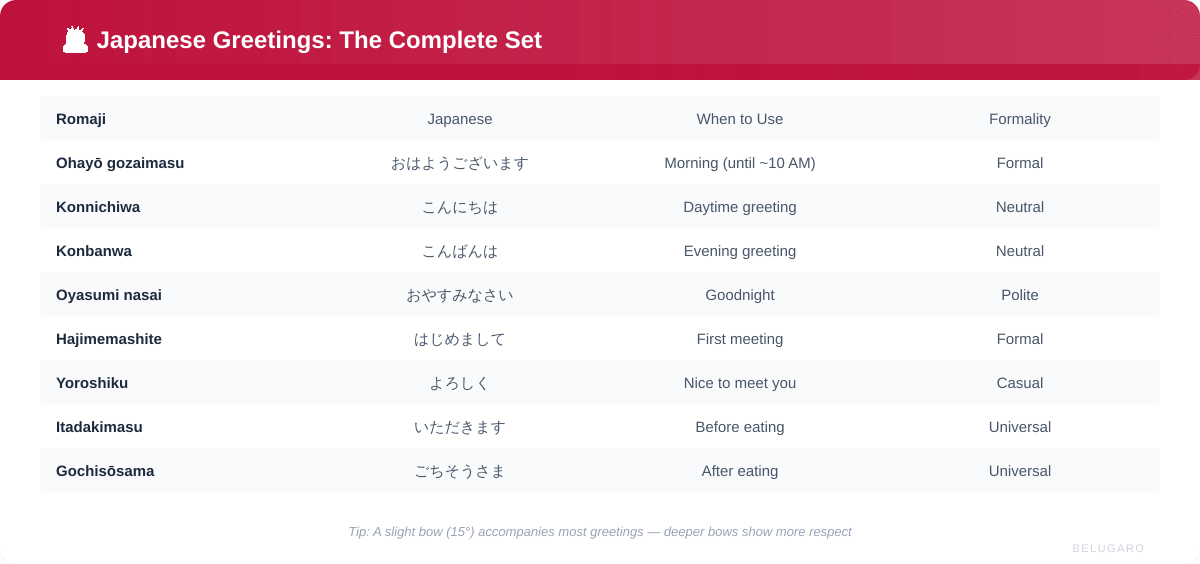
| Japanese | Romaji | Meaning | Time |
|---|---|---|---|
| おはようございます | Ohayō gozaimasu | Good morning (polite) | Until ~10am |
| こんにちは | Konnichiwa | Hello / Good afternoon | ~10am–5pm |
| こんばんは | Konbanwa | Good evening | After ~5pm |
| おやすみなさい | Oyasumi nasai | Good night (polite) | Bedtime |
Pattern: Longer version = polite. Shorter version = casual. This repeats throughout the language.
Pronunciation: Japanese vowels are consistent: a = "father," i = "see," u = "blue," e = "pet," o = "go." Every syllable gets equal stress.
The Multitool: Sumimasen
すみません (Sumimasen) is the Swiss Army knife of Japanese. Depending on context:
- "Excuse me" — getting a waiter's attention
- "I'm sorry" — bumping into someone
- "Thank you" — when someone goes out of their way for you
You'll hear it constantly. Learn to deploy this one word and you'll handle half of daily Japanese social situations.
Restaurant & Shopping Phrases
| Japanese | Romaji | Meaning |
|---|---|---|
| すみません | Sumimasen | Excuse me (to call waiter) |
| これをください | Kore wo kudasai | This one, please |
| おすすめは何ですか | Osusume wa nan desu ka | What do you recommend? |
| お会計をお願いします | Okaikei wo onegaishimasu | Check, please |
| いくらですか | Ikura desu ka | How much? |
| 美味しいです | Oishii desu | It's delicious |
Important: In Japan, you do not tip. It can cause confusion or embarrassment. Service is part of the job, done with professional pride.
Before and After Every Meal
いただきます (Itadakimasu) before eating — "I humbly receive." Gratitude to everyone who made the meal possible.
ごちそうさまでした (Gochisōsama deshita) after eating — thanks for the effort of preparing food. Skipping these at a shared meal is like leaving without thanking the host.
Self-Introduction Template
- はじめまして (Hajimemashite) — Nice to meet you
- [Name]ともうします — I'm called [Name]
- [Country]からきました — I'm from [Country]
- よろしくおねがいします (Yoroshiku onegaishimasu) — "Please treat me well" (no clean English equivalent — it's humility, goodwill, and cooperation in one phrase)
Reading the Air
空気を読む (kūki wo yomu) — "to read the air." If a colleague responds to your proposal with "Sō desu ne..." followed by silence, that's probably a polite "no." Japanese communication values what's not said as much as what is.
Start Learning in Context
These phrases are your foundation. Belugaro helps you build on them by introducing Japanese vocabulary into your regular web browsing — so you absorb words naturally, the way your brain is designed to learn.
Learn Languages While You Browse
Belugaro translates words on any website, helping you build vocabulary naturally. Try it free.
Get the Chrome Extension