Korean Basic Phrases: Your First 50 Words
Learn your first 50 Korean words and phrases. Master essential greetings, K-culture expressions, and understand the honorific system with practical examples.
Korean Basic Phrases: Your First 50 Words
Ask a Korean person their age within five minutes of meeting them, and they won't be offended — they'll be relieved. Age determines which words you use, how you conjugate your verbs, and how deep you bow. It shapes the entire conversation.
Hangul: Learn to Read in an Afternoon
Hangul (한글) was deliberately designed to be easy to learn. Consonant shapes mimic your mouth position when making the sound. Letters combine into syllable blocks. Most people can read Hangul in 2–4 hours.
| Consonants | Vowels | ||
|---|---|---|---|
| ㄱ = g/k | ㅁ = m | ㅏ = a | ㅗ = o |
| ㄴ = n | ㅂ = b/p | ㅓ = eo | ㅜ = u |
| ㄷ = d/t | ㅅ = s | ㅡ = eu | ㅣ = i |
| ㄹ = r/l | ㅇ = silent/ng | ㅐ = ae | ㅔ = e |
ㅎ + ㅏ + ㄴ = 한 (han). ㄱ + ㅜ + ㄱ = 국 (guk). Together: 한국 (Hanguk) = Korea.
Polite vs. Casual: Don't Skip This
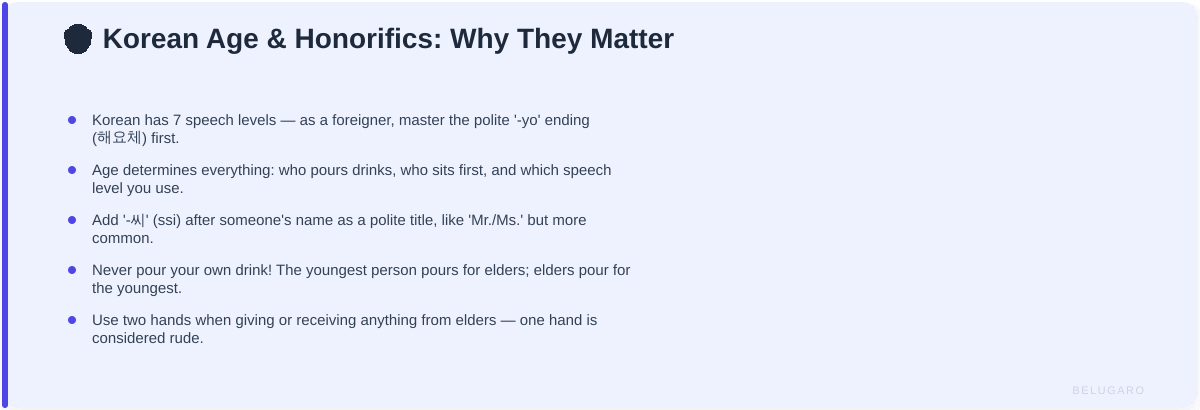
존댓말 (jondaenmal) = polite speech. 반말 (banmal) = casual speech. Using banmal with someone older or someone you just met is a serious social error.
The practical difference: polite phrases end in -yo (요) or -mnida (습니다). Drop those endings and you're speaking banmal. As a foreigner, always use polite forms.
Greetings (1–8)
| # | Korean | Romanization | Meaning |
|---|---|---|---|
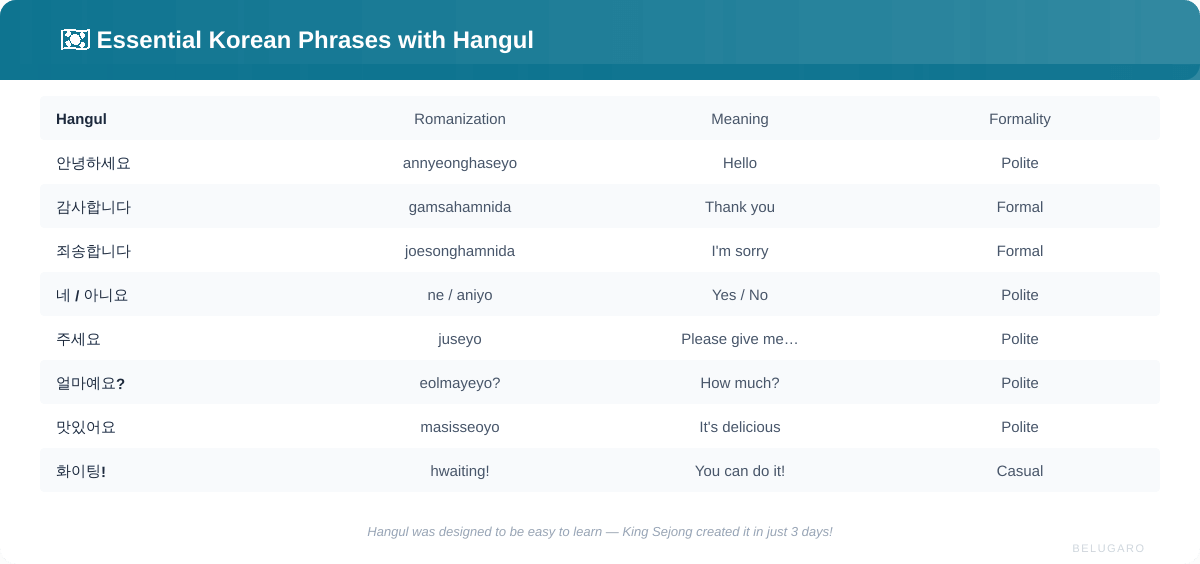
| 1 | 안녕하세요 | annyeonghaseyo | Hello |
| 2 | 안녕히 가세요 | annyeonghi gaseyo | Goodbye (to someone leaving) |
| 3 | 안녕히 계세요 | annyeonghi gyeseyo | Goodbye (to someone staying) |
| 4 | 감사합니다 | gamsahamnida | Thank you (formal) |
| 5 | 죄송합니다 | joesonghamnida | I'm sorry (formal) |
| 6 | 네 | ne | Yes |
| 7 | 아니요 | aniyo | No |
| 8 | 만나서 반갑습니다 | mannaseo bangapseumnida | Nice to meet you |
Two different goodbyes — Korean distinguishes between the person leaving (gaseyo, "go" verb) and the person staying (gyeseyo, "stay" verb).
Food & Dining (9–20)
| # | Korean | Romanization | Meaning |
|---|---|---|---|
| 9 | 잘 먹겠습니다 | jal meokgesseumnida | I will eat well (before eating) |
| 10 | 잘 먹었습니다 | jal meogeosseumnida | I ate well (after eating) |
| 11 | 맛있어요 | masisseoyo | It's delicious |
| 12 | 물 주세요 | mul juseyo | Water, please |
| 13 | 메뉴 주세요 | menyu juseyo | Menu, please |
| 14 | 이거 주세요 | igeo juseyo | This one, please |
| 15 | 얼마예요? | eolmayeyo? | How much? |
| 16 | 계산해 주세요 | gyesanhae juseyo | Check, please |
| 17 | 반찬 | banchan | Side dishes (refillable for free) |
| 18 | 소주 | soju | Korean rice liquor |
| 19 | 치맥 | chimaek | Fried chicken + beer (a cultural institution) |
| 20 | 맵지 않게 해주세요 | maepji anke haejuseyo | Not spicy, please |
여기요 (yeogiyo, "over here!") is how you call a server. It's called out loudly. This isn't rude in Korea — it's expected.
Getting Around (21–28)
| # | Korean | Romanization | Meaning |
|---|---|---|---|
| 21 | 어디예요? | eodiyeyo? | Where is it? |
| 22 | 화장실 어디예요? | hwajangsil eodiyeyo? | Where's the restroom? |
| 23 | 지하철역 | jihacheol-yeok | Subway station |
| 24 | 오른쪽 / 왼쪽 | oreunjjok / oenjjok | Right / Left |
| 25 | 직진 | jikjin | Straight ahead |
| 26 | 도와주세요 | dowajuseyo | Please help me |
| 27 | 택시 | taeksi | Taxi |
| 28 | 여기요 | yeogiyo | Over here! (to get attention) |
Useful Expressions (29–38)
| # | Korean | Romanization | Meaning |
|---|---|---|---|
| 29 | 괜찮아요 | gwaenchanayo | It's okay / I'm fine |
| 30 | 주세요 | juseyo | Please give me |
| 31 | 잠깐만요 | jamkkanmanyo | Just a moment |
| 32 | 모르겠어요 | moreugesseoyo | I don't know |
| 33 | 한국어 못해요 | hangugeo mothaeyo | I can't speak Korean |
| 34 | 천천히 말해 주세요 | cheoncheonhi malhae juseyo | Please speak slowly |
| 35 | 영어 할 수 있어요? | yeongeo hal su isseoyo? | Can you speak English? |
| 36 | 사랑해요 | saranghaeyo | I love you |
| 37 | 이름이 뭐예요? | ireumi mwoyeyo? | What's your name? |
| 38 | 저는 [name]이에요 | jeoneun [name]-ieyo | I'm [name] |
K-Culture Words You Already Know (39–50)
| # | Korean | Romanization | Meaning |
|---|---|---|---|
| 39 | 대박 | daebak | Amazing / Jackpot |
| 40 | 화이팅 | hwaiting | You can do it! (from English "fighting") |
| 41 | 아이고 | aigo | Oh my / Oh dear |
| 42 | 진짜 | jinjja | Really? / Seriously |
| 43 | 헐 | heol | OMG / Whoa |
| 44 | 오빠 | oppa | Older brother (from a woman) / close older male |
| 45 | 눈치 | nunchi | Social awareness / reading the room |
| 46 | 언니 | eonni | Older sister (from a woman) |
| 47 | 형 | hyeong | Older brother (from a man) |
| 48 | 누나 | nuna | Older sister (from a man) |
| 49 | 맞아 | maja | That's right |
| 50 | 파이팅 | paiting | Fighting! (alternate spelling) |
눈치 (nunchi) — "eye measure." The ability to read a room and respond to unspoken expectations. Considered a form of intelligence in Korean culture, as important as book smarts.
Build Your Vocabulary
These 50 words are your entry point. Belugaro helps you build on them by weaving Korean vocabulary into your everyday web browsing — so you encounter words naturally, the way your brain is designed to learn them.
Learn Languages While You Browse
Belugaro translates words on any website, helping you build vocabulary naturally. Try it free.
Get the Chrome Extension