Spanish Verb Conjugation: The Only Cheat Sheet You Need
Master Spanish verb conjugation with visual charts for present, past, and future tenses. Covers regular -ar, -er, -ir verbs and key irregulars like ser, estar, and ir.

Spanish Verb Conjugation: The Only Cheat Sheet You Need
Spanish has three verb families: -ar, -er, and -ir. The good news? -ar verbs make up the vast majority, and they're the most predictable of the bunch.
Present Tense: Your Workhorse
This is the tense you'll use 80% of the time — current actions, habits, and casual future plans.
| Pronoun | hablar (-ar) | comer (-er) | vivir (-ir) |
|---|---|---|---|
| yo | hablo | como | vivo |
| tú | hablas | comes | vives |
| él/ella/usted | habla | come | vive |
| nosotros/as | hablamos | comemos | vivimos |
| vosotros/as | habláis | coméis | vivís |
| ellos/ustedes | hablan | comen | viven |
The shortcut: The yo form always ends in -o. The -er and -ir groups share every ending except nosotros and vosotros. That's two fewer sets to memorize.
Preterite: The "Done and Dusted" Tense
Completed actions. Something happened, it's over.
| Pronoun | hablar (-ar) | comer (-er) | vivir (-ir) |
|---|---|---|---|
| yo | hablé | comí | viví |
| tú | hablaste | comiste | viviste |
| él/ella/usted | habló | comió | vivió |
| nosotros/as | hablamos | comimos | vivimos |
| ellos/ustedes | hablaron | comieron | vivieron |
-er and -ir verbs share identical preterite endings. Learn one, get the other free.
Preterite vs. Imperfect: The One Distinction That Matters
This trips up everyone. It's not about when — it's about how you frame it.
- Preterite = snapshot: Ayer comí paella. (Yesterday I ate paella — done.)
- Imperfect = video: Cuando era niño, comía paella todos los domingos. (As a kid, I used to eat paella every Sunday — ongoing.)
When both appear together, the imperfect sets the scene and the preterite interrupts it: Llovía cuando salí de casa. (It was raining when I left.)
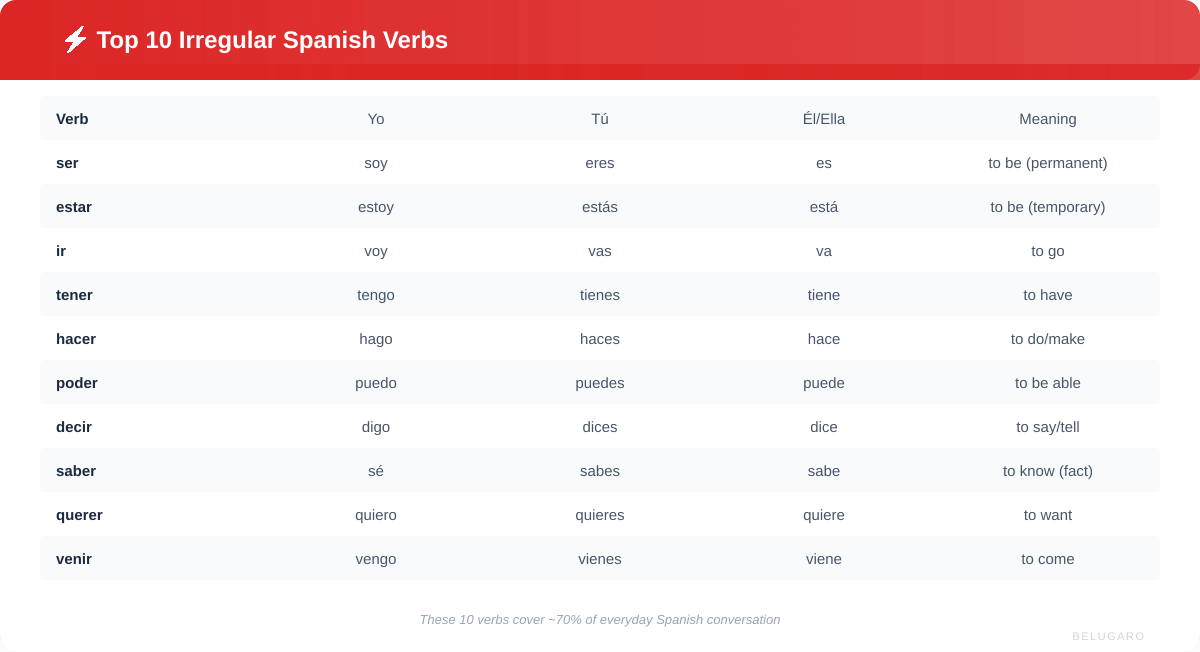
The Big Five Irregulars
These break the rules but show up constantly. You'll internalize them through sheer repetition.
| Verb | Present (yo) | Preterite (yo) | Meaning |
|---|---|---|---|
| ser | soy | fui | to be (permanent) |
| estar | estoy | estuve | to be (temporary) |
| ir | voy | fui | to go |
| tener | tengo | tuve | to have |
| hacer | hago | hice | to do/make |
Fun fact: ser and ir share identical preterite forms. Fui means both "I was" and "I went." Context always makes it obvious.
Vosotros vs. Ustedes
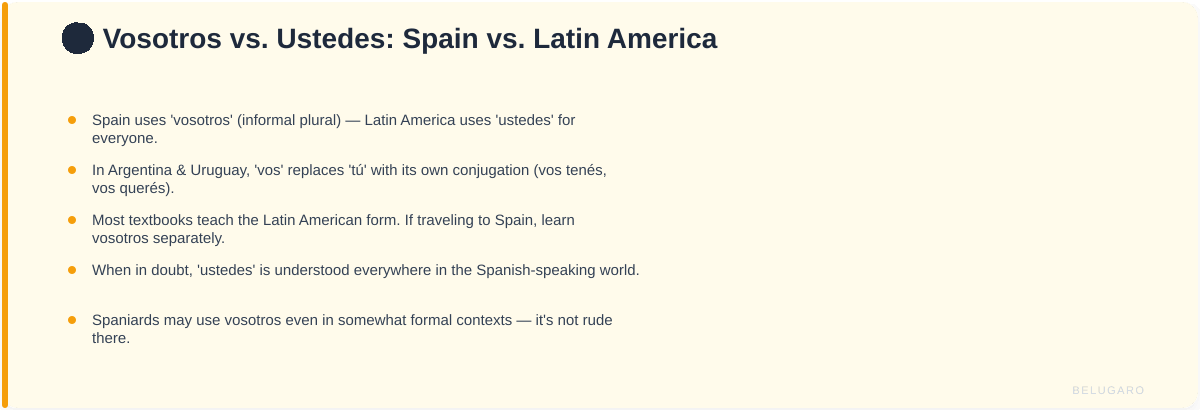
Spain uses vosotros (informal plural "you") constantly among friends. Latin America skips it entirely — everyone uses ustedes for both formal and informal.
Starting out? Learn ustedes first. It works everywhere, including Spain.
Building Conjugation Instinct
Tables get you started, but pattern recognition gets you fluent. The fastest path is seeing conjugated verbs in real sentences — over and over — until your brain stops calculating and just knows. That's exactly what Belugaro does: it weaves Spanish vocabulary into the web pages you already read, turning passive browsing into active learning.
Learn Languages While You Browse
Belugaro translates words on any website, helping you build vocabulary naturally. Try it free.
Get the Chrome Extension